- Collection: Europe of the Future
- Season: Fall/Winter 1992-93
- Location: Paris – Carrousel du Louvre
- Theme: Reimagined European identity
Ehristy Turlington, Eva Herzigova, and Nadja Auermann
After recently finishing an article on Gaultier’s Autumn/Winter 1995/96 collection, in which technology played such an integral part, and investigating the futuristic headpieces while writing about the men’s Autumn/Winter 1992/93 collection, it was easy to assume that the “future” in “Europe of the Future” (L’Europe de l’avenir) had a science-fiction meaning.
However, while investigating this collection, I found some interesting interpretations and noticed recurring themes. One is the reversal of ordinary layering, as seen in the combination of an apron worn over a beautifully tailored pinstripe jacket from Jean Paul Gaultier’s Spring/Summer 1988 collection, The Concierge Is on the Staircase.
Another recurring element is Gaultier’s use of Fair Isle knits, which appear in collections such as “Memories of Buried Pasts, As Time Goes By” F/W 1990–91, and “Le Grand Voyage” F/W 1994–95.
The Sweater Goes Over the Jacket: Unconventional Layering in L’Europe de l’avenir
One of the most interesting themes in L’Europe de l’avenir reverses the familiar order of getting dressed. In one look, a woollen Junior Gaultier shrug is worn over a faux leather jacket, wrapping around the shoulders and upper body. The pattern adds another facet to the story. The wool knit has a distinctly Nordic/Tyrolean character, linking it to the traditional-looking knitwear we see elsewhere in “L’Europe de l’avenir”. Yet it sits over a contemporary jacket, creating a combination of traditional-looking wool, modern outerwear and deliberately unconventional layering. The combination of traditional-looking knitwear and long gravity-defying braids also brings to mind Heidi and Pippi Longstocking, although I haven’t found evidence that Gaultier cited either character as an inspiration.
There’s an interesting story behind this kind of layering. In September 1992, Los Angeles Times fashion editor Mary Rourke wrote about how Gaultier often took inspiration from things he saw in everyday life and translated them into fashion. Gaultier told her that he had once seen “a homeless man wearing a pullover sweater on top of his overcoat” and had used the idea that season.
The same article also looked back at an earlier Gaultier collection, describing models wearing “Fair Isle sweaters over sequined evening sheaths”, together with ski boots, tweed jackets, hoods and feather boas – all worn together.
Later in the show, we see unbuttoned dresses worn over tailored suits, leaving the shirt, tie and suit jacket visible underneath. The effect is striking because Gaultier doesn’t try to disguise either garment. The tailoring remains clearly visible beneath the dress, so that the two different clothing systems become part of the same silhouette.
From Lederhosen to Tailoring: Alpine Influences in Gaultier’s A/W 1992–93 Collection
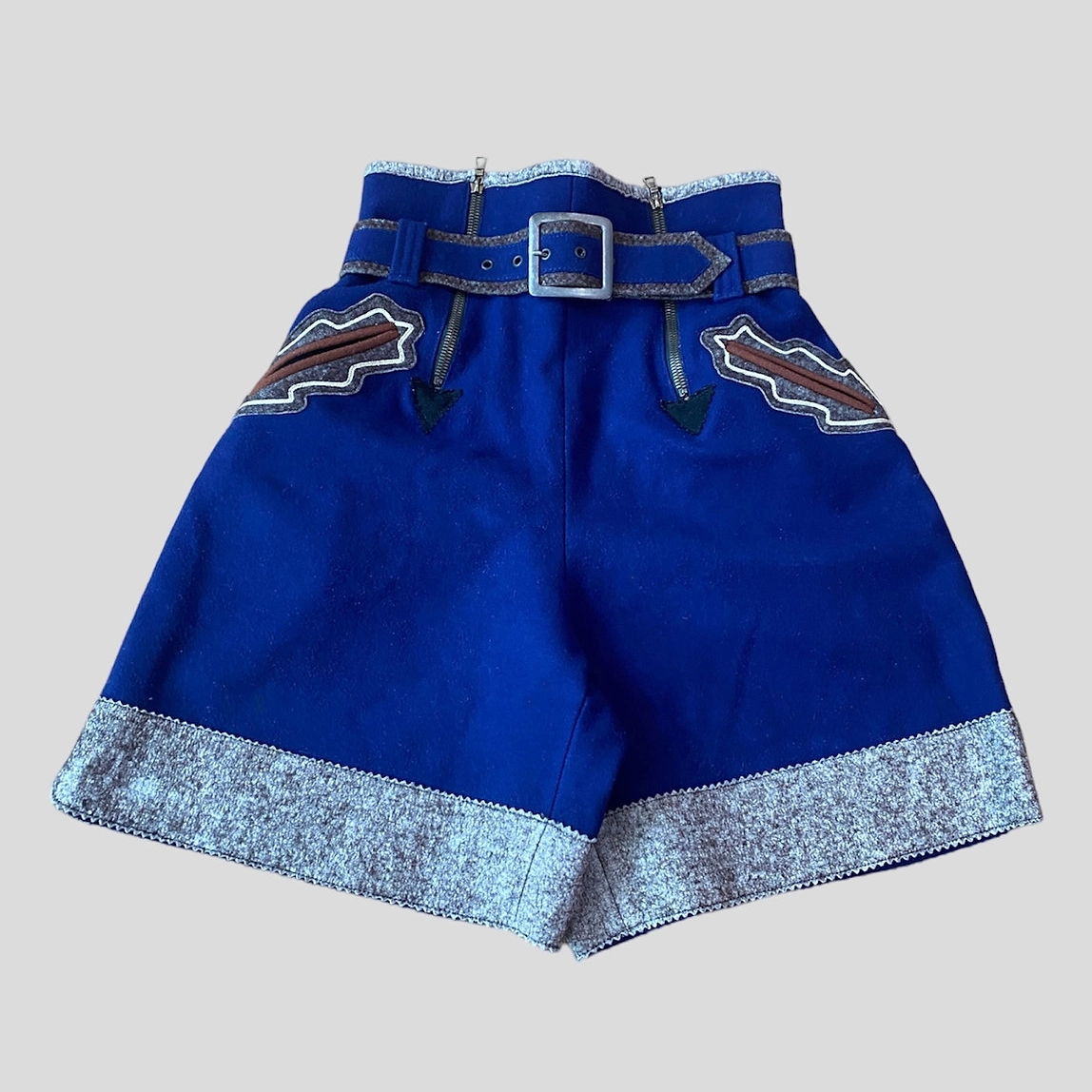
Gaultier’s references to traditional dress are not limited to patterns. Shorts and jackets from the Junior Gaultier line feature pockets formed from curved, leaf-shaped appliqués with central slits and contrasting decorative edging. Their shape and construction closely recall the ornamental pockets found on lederhosen, but here the detail has been transferred from Alpine leather shorts to tailored suits.
There is another particularly striking reference in the dresses from the collection. The straps used to frame the breasts on some of the body-conscious dresses resemble the braces and broad horizontal chest construction of the Quersattel found on lederhosen. Here, the familiar idea of straps running over the torso is transplanted onto an entirely different type of garment.
The effect is particularly provocative because Gaultier combines this traditional-looking construction with the exposed female body. On the catwalk, Eva Herzigova wears a black pinstriped dress where the straps no longer hold up a pair of leather shorts; they become part of the architecture of a dress, framing or emphasising the breasts. Whilst Eva’s modesty is spared with some star-shaped pasties, when Madonna wore the dress at Gaultier’s September 1992 amfAR benefit in Los Angeles, she was more exposed.
The Head as a Still Life: Assemblage, Surrealism and the Everyday in L’Europe de l’avenir
Among the most remarkable creations in Jean Paul Gaultier’s L’Europe de l’avenir are the headpieces. At first glance, the elaborate constructions of metal rods, clips, and tubes surrounding the models’ heads look futuristic. Yet on closer examination, the objects incorporated into these structures are often startlingly ordinary.
They include corkscrews, corks, eyeglasses, a cheese grater, a hand whisk, a ladle, toilet rolls, hair rollers, a hairdryer, a mirror, a makeup brush, cigarettes, cigars, pipes, playing cards, banknotes and a jewellery box. Alongside these everyday objects appear more unusual items, including a revolver, a miniature violin, a bird cage containing a stuffed bird, laboratory glassware, a metal hen and a small horn.
I tried to find a pattern in the objects used in each headpiece. Some of the more unusual combinations are easy to dismiss as surrealism, but they also remind me of Marcel Duchamp’s readymades, where ordinary manufactured objects became works of art simply by being put in a different context. Another possibility is that the objects tell us something about the models themselves. Instead of carrying their possessions in pockets or handbags, they display them around their heads. We might have a gambler, a musician or even a scientist walking down the catwalk.