In 1994 Vogue magazine described Jean Paul Gaultier’s Les Tatouages collection of Spring/Summer 1994 as “A startling vision of cross-cultural harmony”.
Twenty years later in a 2015 article on vogue.com, the collection was summed up as “an exhilarating, sometimes bewildering hodgepodge romp of references that included men in skirts, denim cut in eighteenth-century shapes, corsetry, Joan of Arc–style armour, a punkish graffiti print, and a tattoo-currency motif.”
Maison Martin Margiela does tattoos too
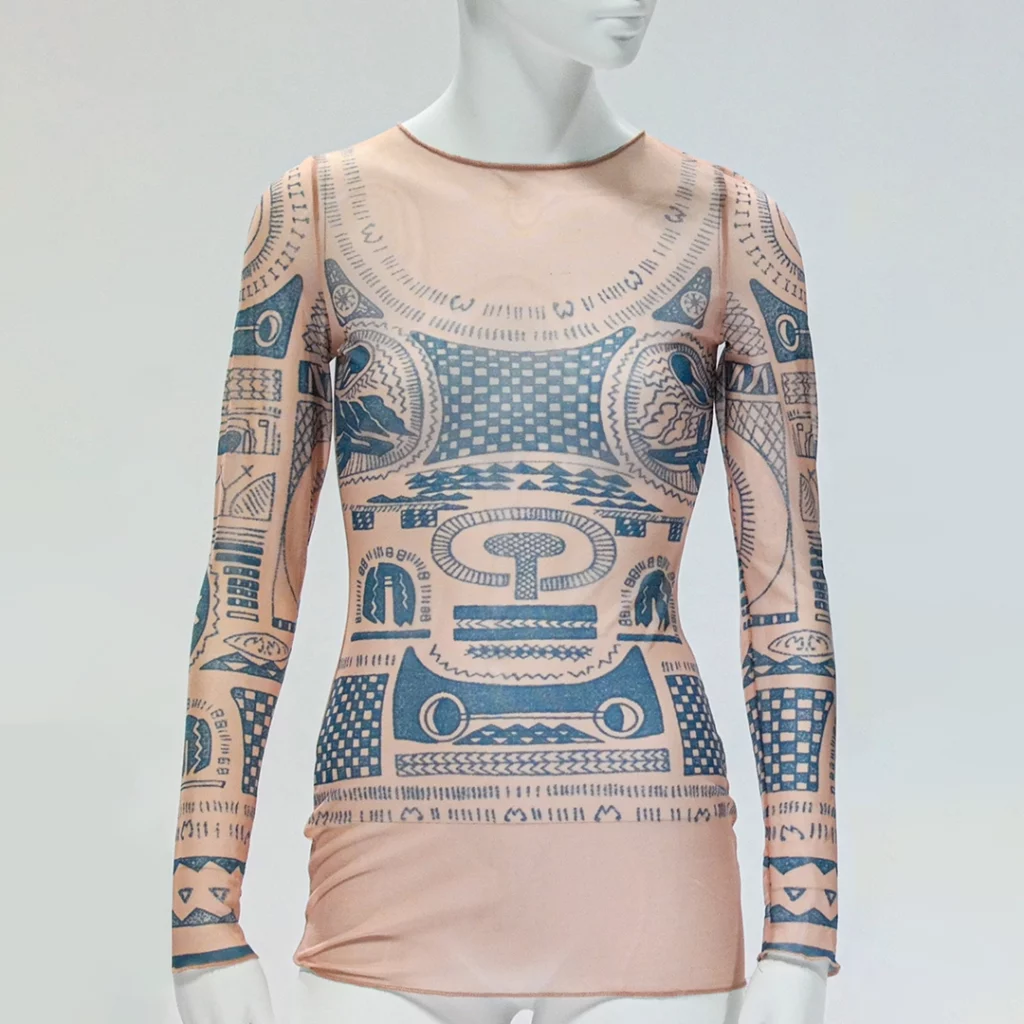
The article highlights the Spring/Summer 1989 collection by Maison Martin Margiela, which included tattoo prints inspired by Aztec culture on nude mesh. This technique gave the impression of inked skin, something that Gaultier did not attempt to accomplish because he used tattoos as a separate element from the clothing.
(Martin Margiela relocated to Paris in 1984 to work as Jean Paul Gaultier’s design assistant after graduating from the Royal Academy of Fine Arts in Antwerp.)
Global village chic – a hybrid of fashion and social commentary

Clearly, a lot is going on in the catwalk presentation, but perhaps “hodgepodge” is a touch harsh. The show features a variety of prints, and yes, there was armour!
Maybe there’s too much going on at once to take in all of the references – sensory overload – but if you slow down the footage or look at individual photos of the models, you can see how different cultures have influenced the various prints, resulting in a hybrid of fashion and social commentary. (There is one print that I find jarring amongst the rest of the collection, and it’s the American blue, red, and white pinup girl print.)
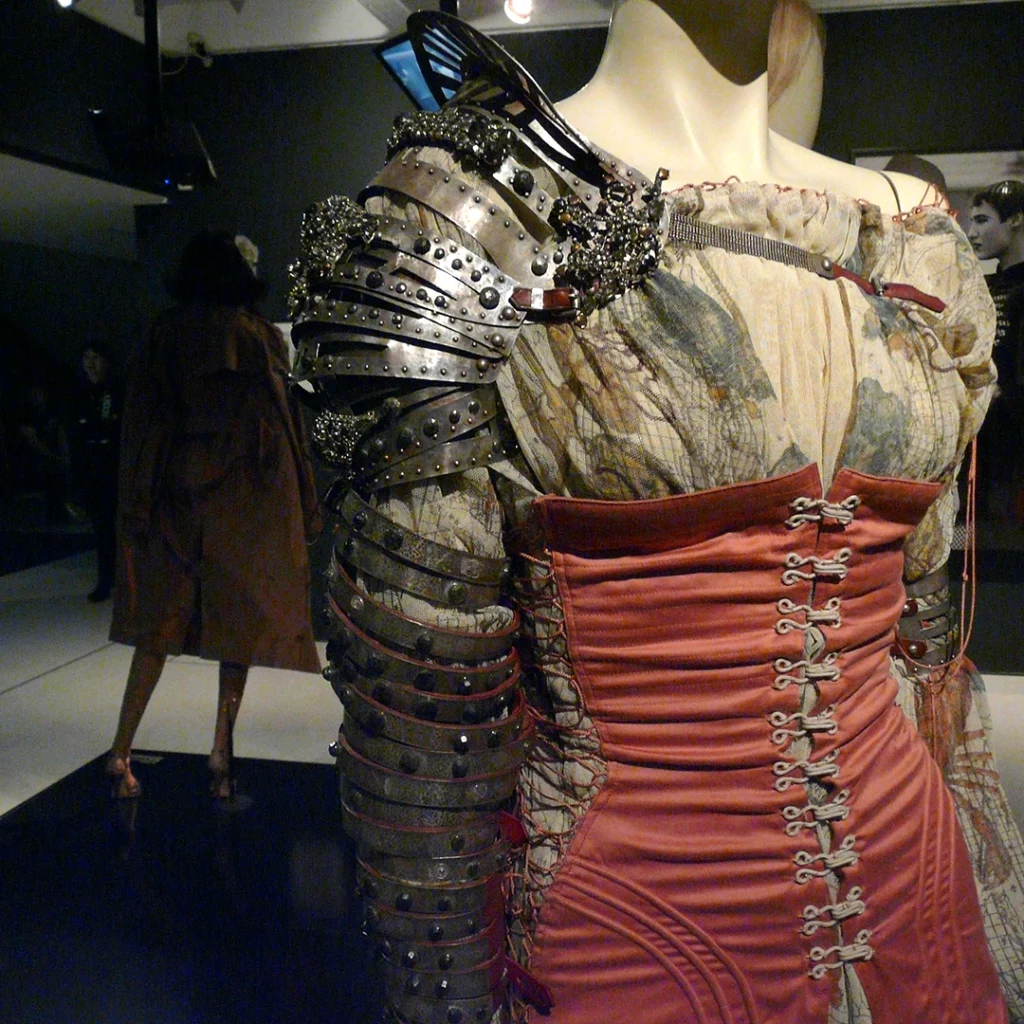
Top notes included African tribal designs and BIG Maasai beads. The much-discussed faux piercings reflected Indian and Southeast Asian cultures, including traditional Hindu nose rings linked by chains to the models’ ears. Simple Hawaiian palm tree woodcut images appeared throughout, in a variant of a design I was already familiar with. There were also Mediaeval armoured arms and legs in a homage to Joan of Arc.
This collection featured a variety of bodily modifications, including models with real tattoos and those adored with fake tattoos. Skin-tight opaque fabrics with elaborate prints replicate sections of the intricate patterns on numerous European paper currencies, including background designs and denominations.
The collection features three Gaultier brands and a variety of strong motifs. In my opinion, that’s what makes the collection so intriguing, as the primary line was supplemented by both the Junior Gaultier and Gaultier Jean brands.
If you’ve seen previous shows, you’ll know that cigarettes on the runway are a Gaultier trademark, albeit in this show, pretending to puff on joss sticks would have suggested Eastern mysticism.
A penchant for pierced body parts
Whereas previous collections inspired by the (London) streets were limited to subcultures such as punk rock and mod, Gaultier stated that 1994’s competing narratives reflected what he observed on the street, albeit the global village streets of Paris.
In a New York Times story about the show, a less than enthusiastic Bernadette Morris saw aspects of punk culture. “His wacky collection could have made you smile, but first you would have had to get past his penchant for pierced body parts. Chains connecting pierced noses with pierced ears were the least of them. Along with his body tattoos, this was part of his homage to punk fashion. It wasn’t very uplifting, but some of the clothes were fun.”
Is this reminiscent of the previous season’s alleged cultural appropriation with the “Chic Rabbis” collection? As of June 2023, India is the world’s most populous country, therefore it is far from a minority. And, as Gaultier himself stated about the collection, “I wanted to point out the tribal roots of body art and offer a little history lesson”.
Gauiltier’s tattoo experience
In a 2014 news article in The Independent newspaper about his new exhibition, The Fashion World of Jean Paul Gaultier: From the Sidewalk to the Catwalk, Gaultier recounts his experience of getting a tattoo himself, which I think was a Tahitian design on his bicep. “I had my first done in 1987, in London, as the one doing the tattoo was very cute, but, alas, he make an ugly one. Bon. I should have choose the one that was doing it well rather than looking well himself! Anyway, in 1991 I went to a tattoo convention, there were these boys and girls with pear-sing [piercing] and tattoo that was incredible.
“Then I realise it’s not a bra – because I see a piercing – it was a tattoo like the bra, the bra was a tattoo! My God, so incredible, so fabulous.”
Jean Paul Gaultier
Gaultier then tells a story that I’ve heard before but in more detail. “One of the things I never forget was an old lady, my age now; she wore a black leather pencil skirt, ‘igh ‘eels, almost white hair, little glasses and a blouse, transparent, very chic, with a bra, printed, oohh. Then I realise it’s not a bra – because I see a piercing – it was a tattoo like the bra, the bra was a tattoo! My God, so incredible, so fabulous. I had already started my collection but now everything I wanted tattoo, tattoo, tattoo, and that was how it start and now I print on the clothes, chiffon, everything.”
The Maltese Cross as a design element
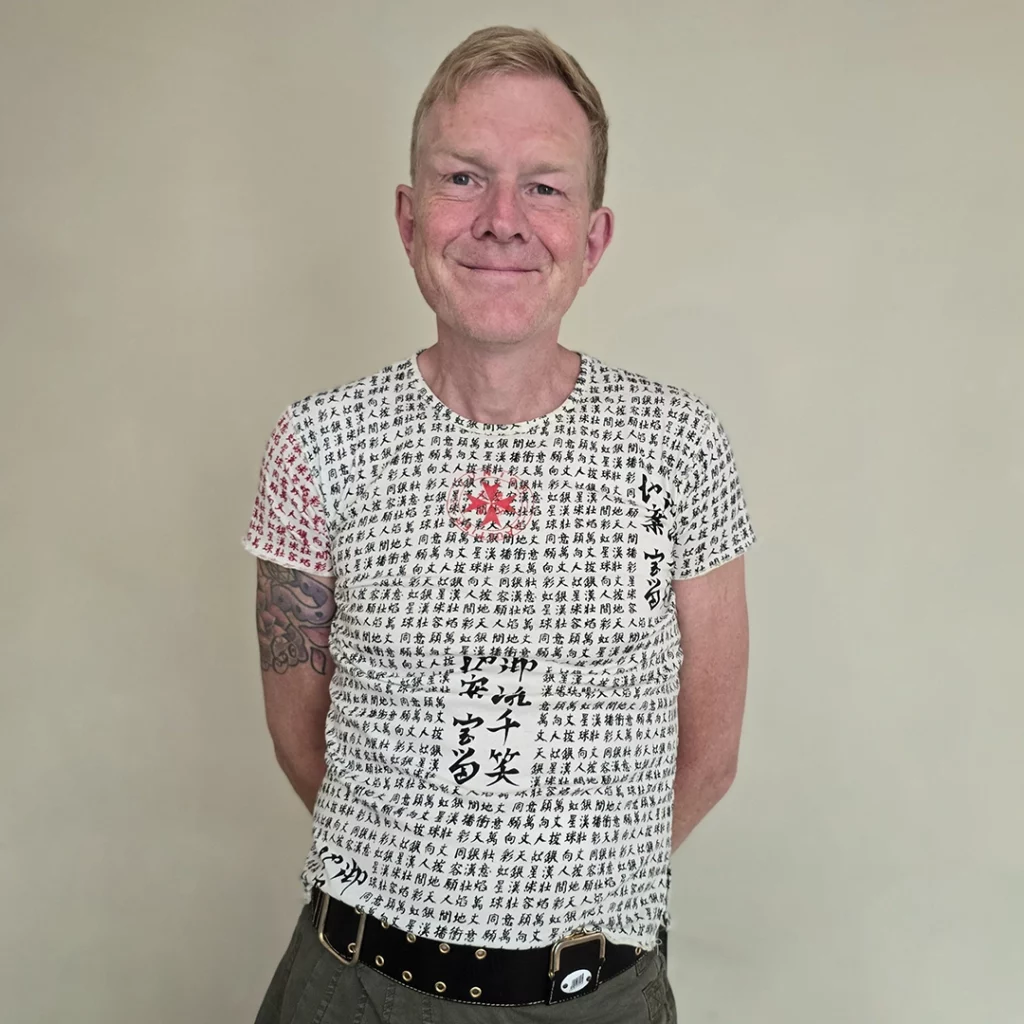
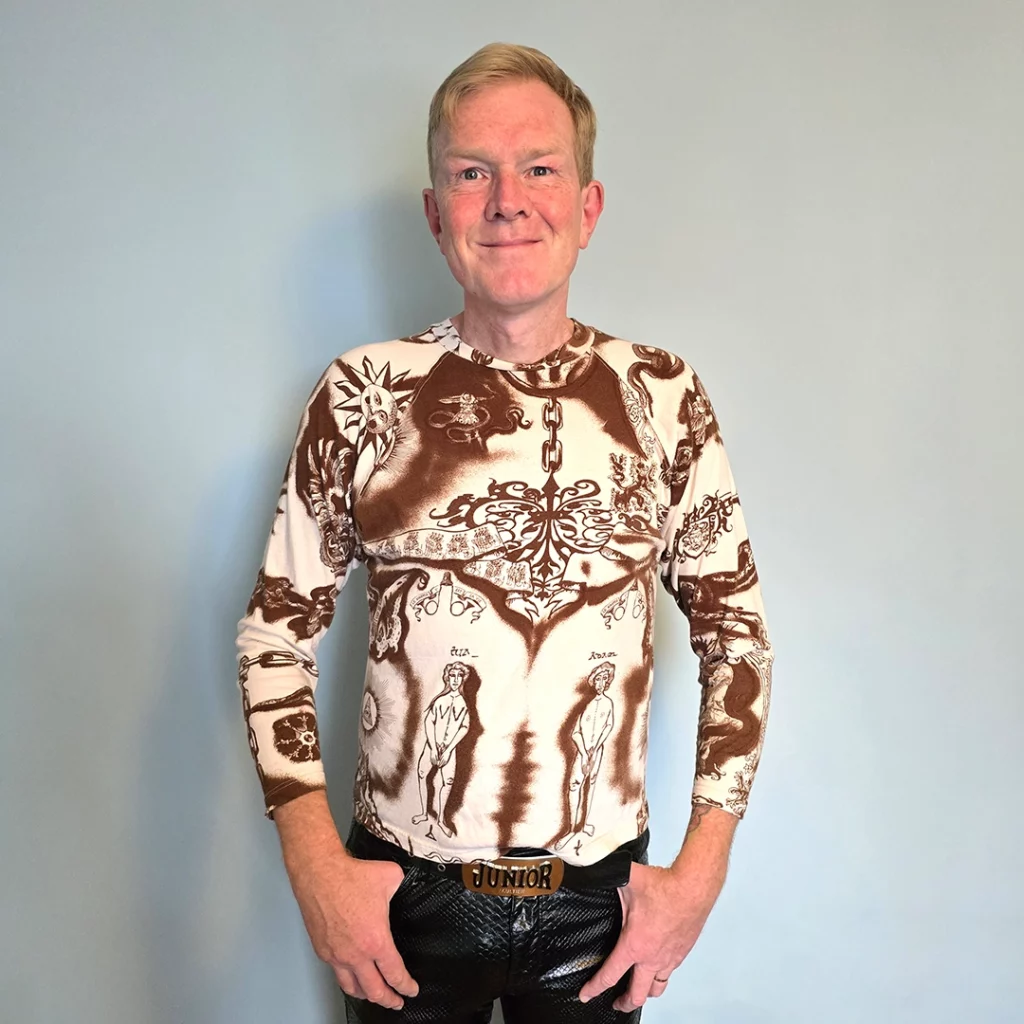
If you look closely at the photo of model Stella Tennant on the catwalk, you’ll see the Japanese writing that features on the Junior Gaultier T-shirt that I am modelling.
The shirt also features an image of the ‘Maltese Cross’ worn by Christian soldiers. during the Crusades and became identified with the Order and Knights of St John once they arrived in Malta. At first sight, the characters encircling the cross appear to be writing. Still, they are actually lions and unicorns that were added to the original cross in 1888 when Queen Victoria granted The Order of St John royal charter. The Lion has been used in heraldry as a symbol for England for centuries accompanied by unicorns the symbol for Scotland.
The Heraldry Tattoo collection
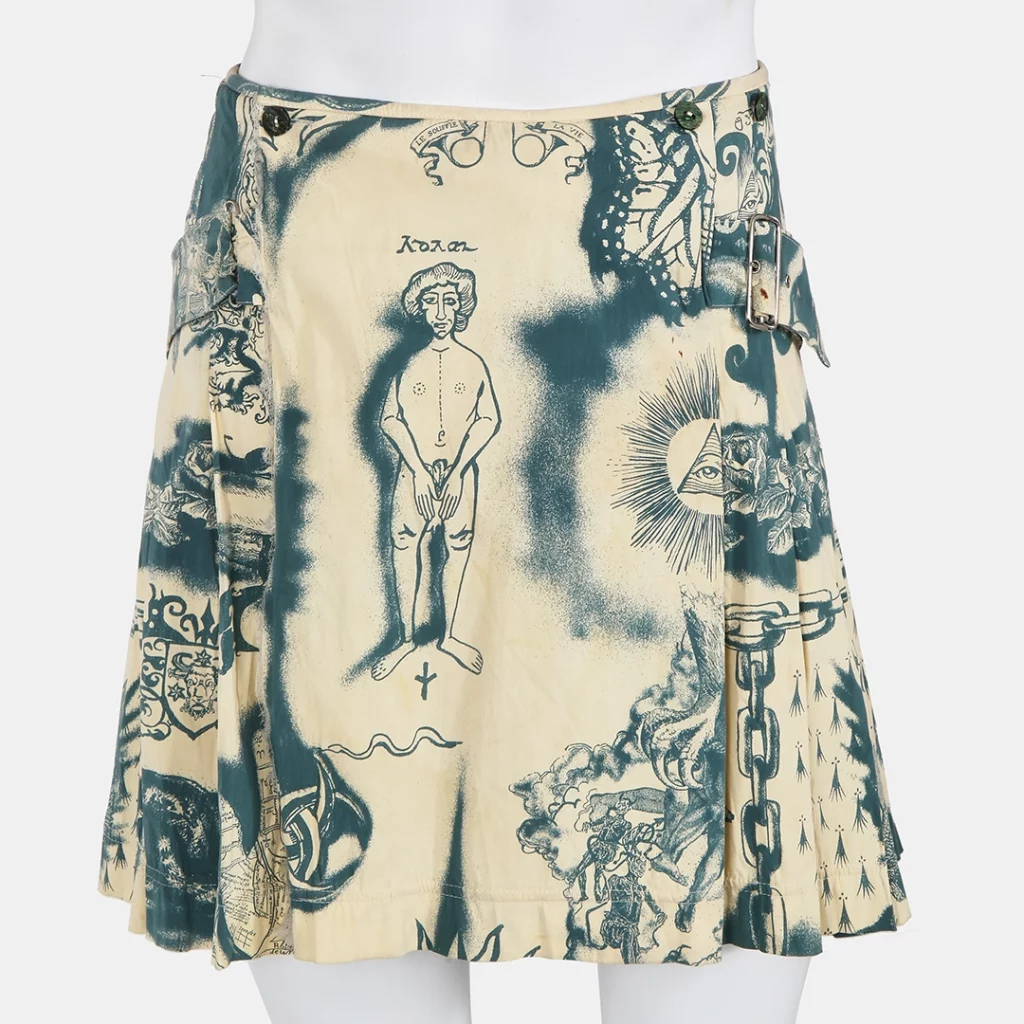
Speaking about heraldry, I’ve been captivated by Gaultier’s recent Heraldry Tattoo design from the 2023 Tattoo Collection. It’s amazing how accurately the print has been copied; I wonder why the original print was never reprinted.
The Tattoo Collection revisits memories of the 1990s, reinventing Jean Paul Gaultier’s universe of tattoos, piercings, body adornments, and images of naked bodies and the unavoidable sailor stripes. I especially enjoy the sun pattern that surrounds a trompe-l’oeil belly button piercing.
Jewellery with an ethnic inspiration
In January 1994’s edition of Vogue an article on bangles and bracelets with an ethnic inspiration, Giorgio Armani’s influences are noted as the Mediterranean regions of Greece, Tunisia, and Sicily, whilst Donna Karan’s bracelets are referred to as “future tribal”. On Gaultier’s contribution to the trend, the article
“Gaultier put a global spin on the bracelets he sent down his spring runway, blending inspiration from the African Masai with a ‘touch of Joan of Arc’. The result: an eccentric, multicultural mix of Virgin Mary medallions, offbeat charms, and intricate ethnic metalwork.”
Joan of Arc is the perfect muse for Gaultier, as a warrior and saint, masculine and feminine
Given that Joan of Arc is France’s patron saint and a strong woman who defies gender norms, it is unsurprising that Gaultier channelled her spirit on the catwalk.
Joan of Arc served as an inspiration for other fashion designers than Gaultier. With articulating armour plates, chain mail gowns, and even a recreation of Joan’s death encircled by a ring of flames, Alexander McQueen honoured her in his spring/summer 1998 collection. In his A/W 2006 haute couture collection for Christian Dior, John Galliano paid homage to Joan of Arc by sending an army of medieval warrior women down the runway.
The “Les Tatouages” show concluded with slices of chainmail replicated in silver sequins, metal studded loops, and suits of armour panels worn over deconstructed corset dresses.
What Vogue had to say about Junior Gaultier
In the April 1994 edition of Vogue US, we are treated to a synopsis of the Junior Gaultier label (albeit during its penultimate season of existence) based on the “Les Tatouages” collection. Junior Gaultier’s separates were described as being in contrasting materials that are toned-down yet more wearable, with details such as massive zippers and industrial strapping. The design is described as unexpectedly simple, yet with unique details such as blended patterns and removable sleeves. Vogue warns us not to expect to see any of Gaultier’s truly bizarre creations, such as the transparent corset-inspired dress with a weighted hem that debuted in this season’s main collection!
“If you’re a dominatrix and want to dress like one, Junior Gaultier is not for you.”
Vogue
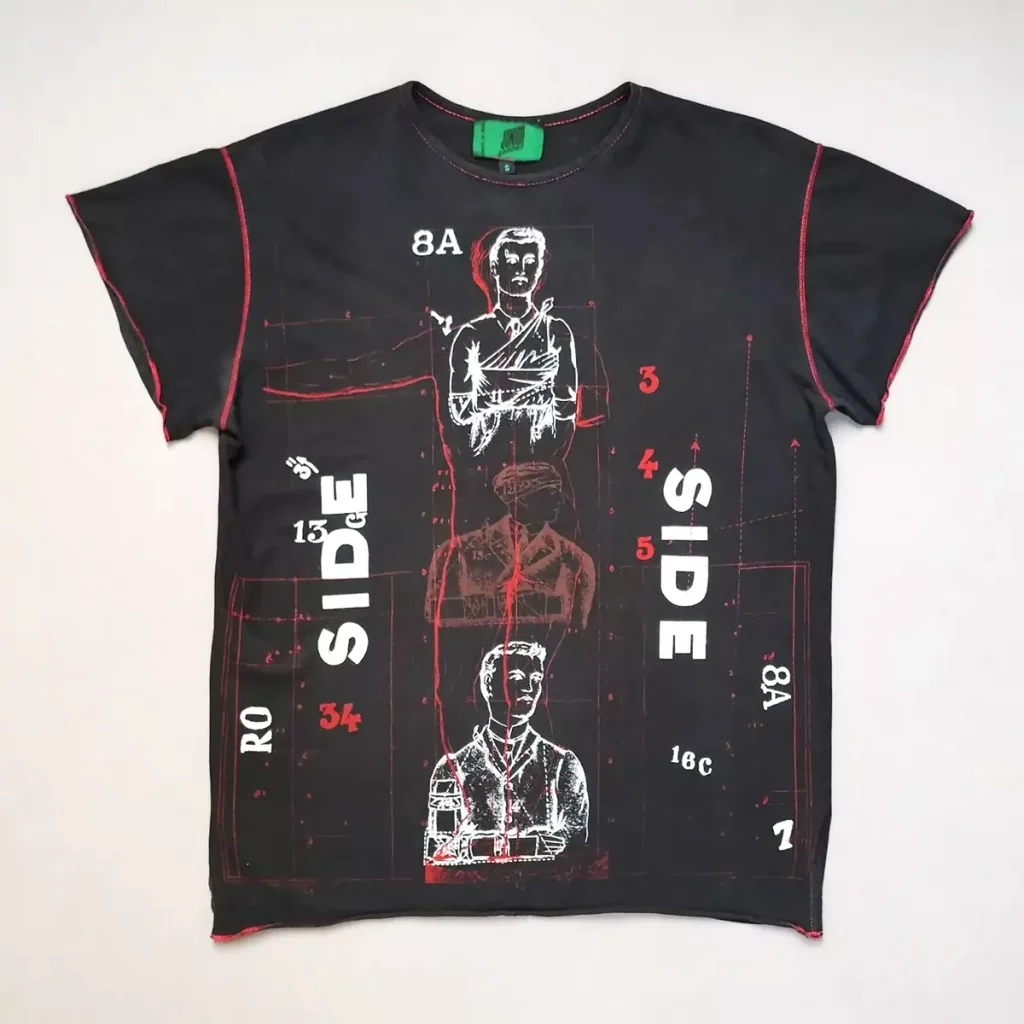
The “biggest bang for the buck” of the collection is apparently a short-sleeved rayon shirt with a print fabric inspired by old medical textbooks. “The theme, alas, is bandages – but it’s pure Gaultier”. The downside of this Junior Gaultier offering, according to Vogue, is quite perplexing, and I’m not sure I understand “If you’re a dominatrix and want to dress like one, Junior Gaultier is not for you. Of course, that’s good news for the rest of us; some items in this line are innocent-looking, even sweet-like the irresistibly light-hearted multipatterned poplin dresses.”
Club kids love Gaultier too
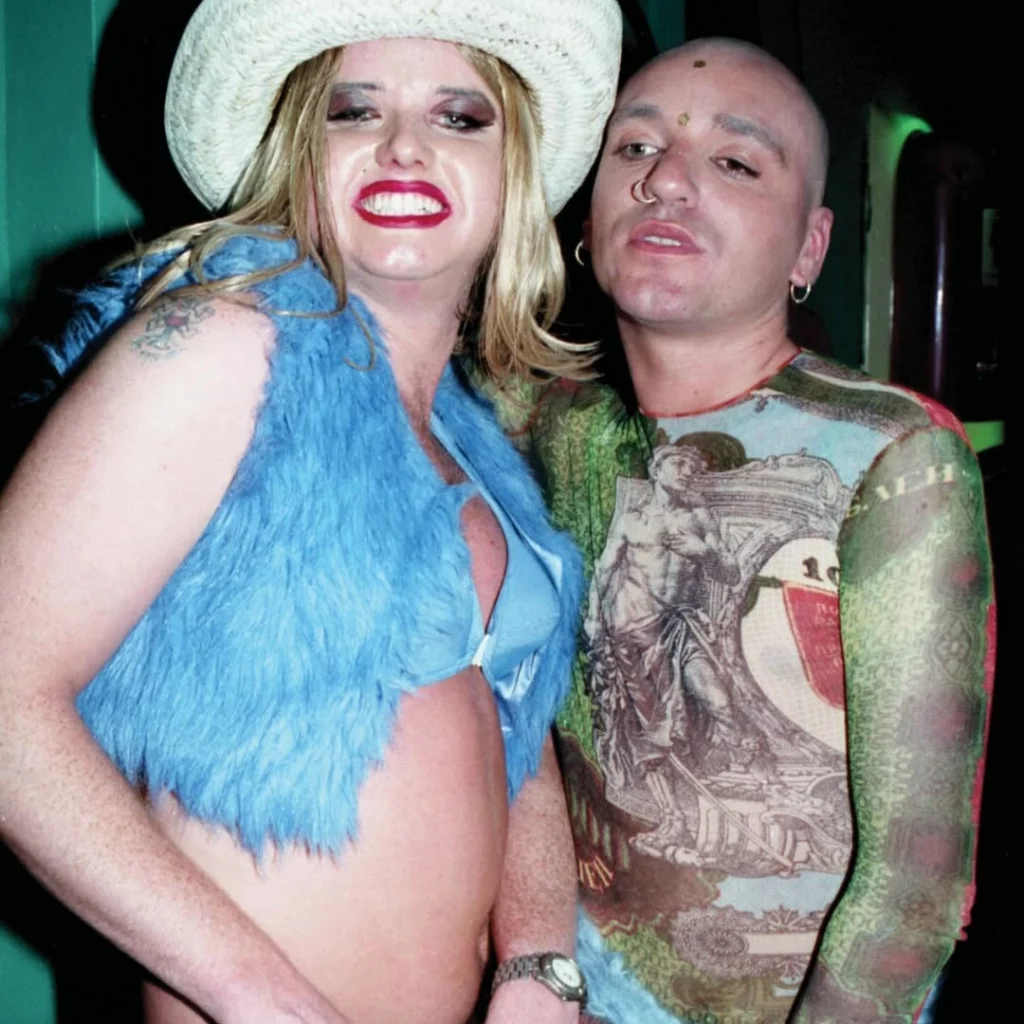
I love to see “real people” wearing fashion, so I had to include this photo taken in Leeds in 1994 by Stuart Linden Rhodes of a person wearing a shirt from Jean Paul Gaultier’s Les Tatouages collection.