
Long before fashion embraced the digital age, Jean Paul Gaultier’s Autumn/Winter 1995–96 Cavalières et Amazones des Temps Modernes imagined a world of cyberpunk Amazons, technological jewellery and futuristic body-mapping prints, creating one of the designer’s most iconic collections.
- Collection: Cavalières et Amazones des Temps Modernes (“Cyber” / “Mad Maxette”)
- Season: Fall/Winter 1995–96
- Location: Paris
- Theme: Cyberpunk Amazons, technology and post-apocalyptic glamour
Claudia Huidobro, Estelle Lefébure, Linda Evangelista, Helena Christensen, and Carmen Dell’Orefice
Although the 1995 fall/winter Cavalières et Amazones des Temps Modernes collection is commonly known as the Cyber show, it is also widely referred to as the Mad Max show. Gaultier claimed backstage that, considering the emphasis on feminine silhouettes, ‘Mad Maxette’ was a more appropriate term. He emphasised that his vision centred on courageous, confident, Amazonian women rather than post-apocalyptic machismo.
In a 2024 article written by Stephanie Sorn for Vogue, on the exhibition CinéMode par Jean Paul Gaultier, the designer explains.
“Cinema has been my constant source of inspiration, and I have made full collections inspired by movies, like my fall/winter ’95 Mad Max collection – or, should I say, “Mad Maxette.” I have been inspired by the scavenger aesthetic of the films and the way it portrayed technology. The collection was intended for an Amazonian woman who is courageous, confident, and very much in control of her life.”
The collection’s models and their dress projected self-sufficiency and resilience, drawing on the scavenged, improvised aesthetic of George Miller’s Mad Max films.
Despite the Junior Gaultier label ending a year earlier, I think this is an important collection for Junior fans as it continues the themes of Les Tatouages and Le Grand Voyage – unconventional beauty and multicultural references – while introducing the influence of digital culture to a tribal generation.
Gaultier mixed futuristic sportswear in the form of technical fabrics and printed lycra with historical references, such as Renaissance velvets embroidered with motherboard-like motifs, making me wonder if the characters in the show had raided a museum to revamp their wardrobes. Alternatively, were they representatives of the Victorian steampunk subgenre of science fiction and a fashion style?
Looking back today, it’s easy to see how the collection anticipated the growing relationship between fashion and technology, as at the time of the collection, Gaultier was also working on the costumes for the science fiction movie The Fifth Element.
“In that period I was doing the clothes for Fifth Element, which you can see also in my collection. It’s not The Fifth Element, but I was into that spirit, you know.“ Jean Paul Gaultier.
Further cementing the collection into fashion history, the show was memorable for a number of reasons beyond the clothes. A motorcycle burst through a cloud of smoke to open the show, Carmen Dell’Orefice carried a hawk, and visibly pregnant model Claudia Huidobro walked out, challenging conventional runway casting.
Who is Mad Max?
If you haven’t seen the original (or any other) Mad Max movie, it’s set in a dystopian near-future Australia which is facing a breakdown of civil order primarily owing to widespread oil shortages and humanity’s destruction of the environment.
The villainous gangs from the movie wear an aggressive aesthetic characterised by an asymmetrical layering of mismatched, soiled fabrics and scavenged protective sports gear, worn over leather. To further emphasise the apocalyptic punk look, shaggy fur collars and feathers, topped with eclectic helmets and industrial eyewear, were worn.
Despite the original Mad Max being released in French cinemas in 1982, three years after its 1979 premiere in Australia, the film’s director, George Miller, claimed, “It was the French who really picked up on the first Mad Max movie. The French were the first to say that these movies are Westerns on wheels.”
Victor Vasarely and the Cyberdot Print

Alongside post-apocalyptic leather, fur, and feathers, the collection is much more than film costumes – there’s the “Cyberdot” print.
One of the most memorable aspects of the collection was a futuristic dotted print using trompe-l’œil and optical illusion, influenced by Victor Vasarely, known as the father of Op Art, a style incorporating optical effects to create a sense of movement. The pattern gave the impression that the body had been scanned, rendered, then reproduced back into flesh.
“I wanted to make the shape of a body in the Vasarely optical way”, Gaultier told Vogue.
Strewn across dresses and hooded catsuits, the designs appeared to map the contours of the models, transforming their bodies into a living digital landscape and reemphasising the athletic, Amazonian physique. These garments would later become some of the most collectable pieces from Gaultier’s career and have been frequently revived in contemporary fashion and celebrity styling, worn by figures such as Iggy Azalea, Kim Kardashian, Kendall Jenner, Cardi B, Chloë Bailey and, more recently, Bad Bunny. Featuring the now legendary cyber-dot print inspired by Victor Vasarely, the pieces have enjoyed a significant resurgence in popularity and were also reissued by the house in 2022.
Jewellery & Accessories: History Meets Technology
In my opinion, jewellery plays less of a part in the show than in other collections. However, there are some quite striking cross-shaped pendants with red accents that resemble cabochons, giving the jewellery a warrior-inspired technological quality and blending found-object aesthetics with religious and industrial references.
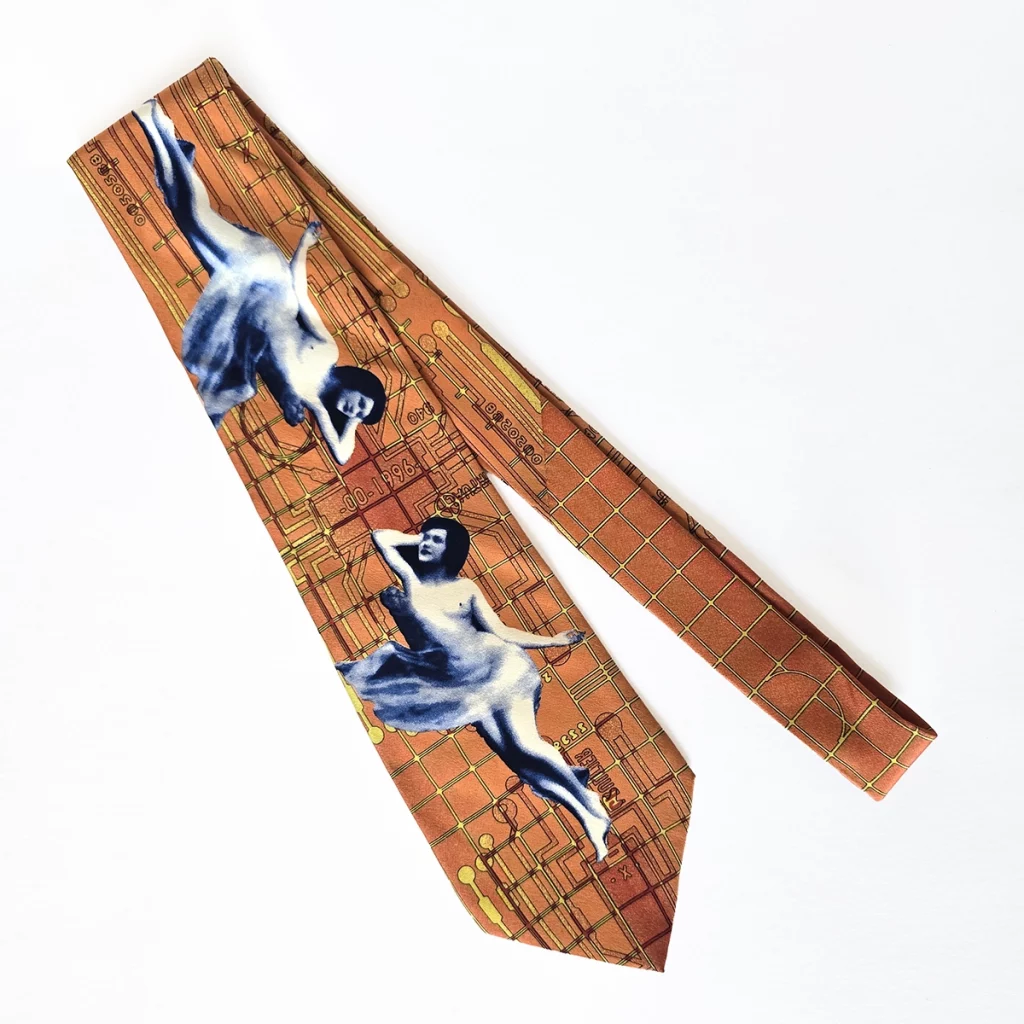
This tie is one of the most striking accessories from the collection. By layering Renaissance-inspired female figures over a printed circuit board, Gaultier merged history and technology into a single design. It’s a small detail that perfectly captures the spirit of the Cyber collection, where the past and the future constantly collide.
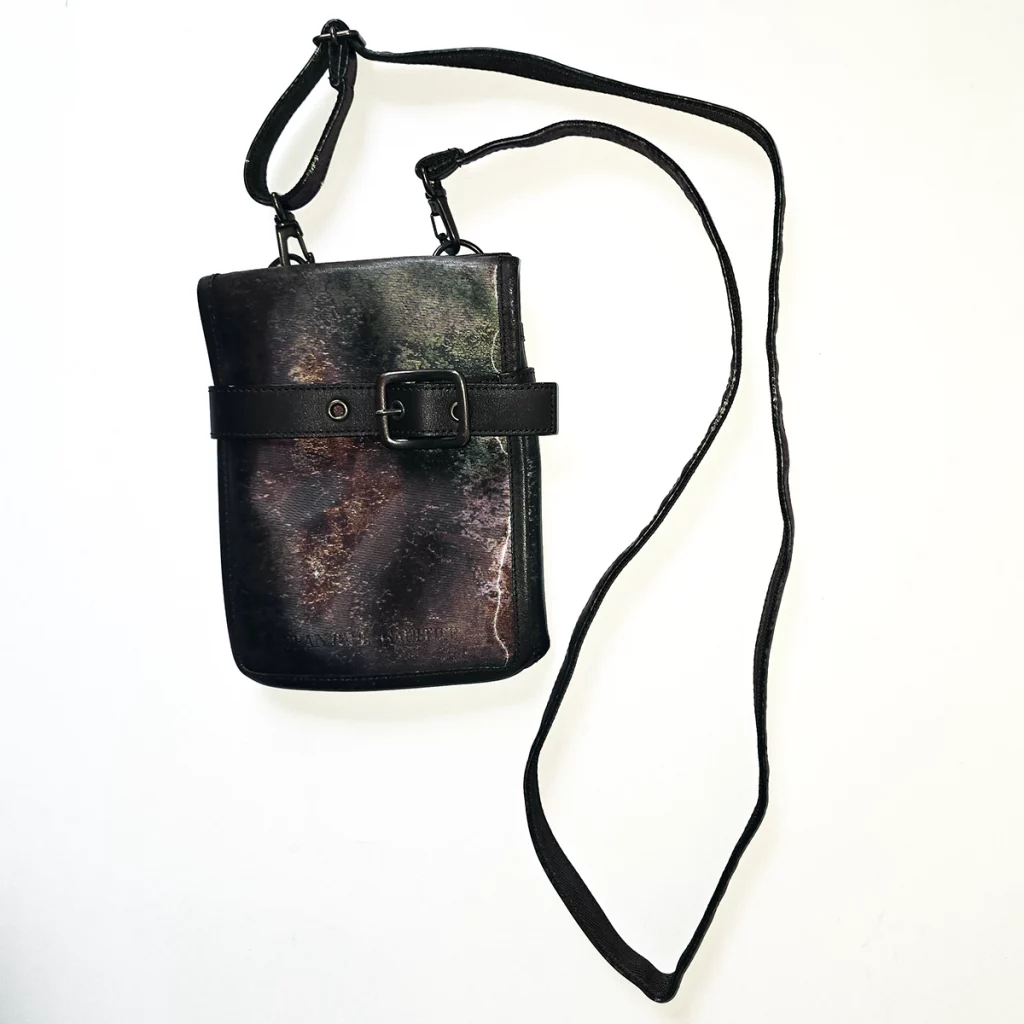
Perhaps the collection’s most recognisable accessory is the range of bags finished with Gaultier’s distinctive metallic patina print. Still regularly found on vintage resale sites, the design mimics the appearance of oxidised copper, blending verdigris greens, burnished browns and oil-slick blues beneath a glossy lacquered finish. Like so much of the collection, the effect is both industrial and strangely beautiful.
Creating the Cyber Look: Topolino’s Digital Makeup and Futuristic Hair
Iconic, highly influential French-Italian international makeup artist Topolino did the makeup for the show, which, when paired with hair in braided styles and dreadlocks, evoked visions of futuristic nomads.
“I wanted something like kind of digital let’s say, like digital makeup, blue makeup on pink hair. Punky, let’s say, even the hair was between the dreadlocks and the Marie Antoinette. It’s a mix of time.”
Topolino’s makeup for the “Cyber” collection transformed the face into a graphic surface rather than enhancing the model’s natural features. Large sharply defined geometric blocks of colour surround one eye, resembling a digital overlay, while the opposite eye is left almost bare, creating strong asymmetry. The natural and minimally shaped complexion forces the bold eye design to dominate. The lips are painted a pale metallic silver, giving them a futuristic, synthetic appearance. I think the look embodies Gaultier’s vision of “digital makeup” and perfectly complements the collection’s tech-tribal aesthetic.
Did Gaultier’s Cyber Makeup Predict Anti-Surveillance Design?
While researching the makeup for the show, I came across comparisons between Topolino’s designs and the experiments by artists in anti-surveillance makeup. Seen in retrospect, the makeup created by Topolino for Gaultier’s collection has striking parallels to the work of artist and researcher Adam Harvey, who developed CV Dazzle, a makeup and hairstyling technique intended to disrupt facial recognition software systems by obscuring features through asymmetry, high-contrast colour and the partial concealment of the eyes and bridge of the nose.
I love this accidental precursor to an aesthetic that disrupts automated facial detection. Whether intentional or not, Gaultier’s vision of “Cyber” anticipated a technological future that had not yet arrived, but one that now raises important questions about facial recognition, data protection and civil liberties.
Almost thirty years on, I still can’t decide whether Gaultier was imagining a world transformed by technology or one recovering from its failure. Maybe that’s exactly the point. Gaultier presented a future where Renaissance velvet, tribal adornment, industrial hardware and digital imagery coexist, leaving us to imagine what happened in between.